History Co-Author. From a one-line seed to a finished narrative history
Step1
The whole system is three files. 1,743 lines of craft. The genre, the record rules, and the tells that give AI history away.
C
The Army That Vanished⋯
How can I help you today?
Let's plan my narrative history book.
Read the framework, the style pack and the setup guide in full ›
I created Book Files, Chapters, Old Book States and Research Sources in your book's folder. Anything you have gathered yourself, a PDF, a transcription, a scan, can go in Research Sources. It is never required.
Let's build your book. First, give me your starting point.
This can be anything: a subject you've always wanted to read a real book about, a person, a place, a year, a disaster, a voyage, a trial, a company, a family, a question you've never seen answered, a document you found, or a detailed wishlist of everything you want. A single word works. Twenty pages of notes work.
Or say "surprise me" and I'll find a story from scratch.
One note on language: the book will be written in American English by default. If you want another English variant, or a different language entirely, tell me now.
Reply…
This can be anything…
Or say "surprise me" and I'll find a story from scratch.
One note on language: the book will be written in American English by default. If you want another English variant, or a different language entirely, tell me now.
My seed for The Army That Vanished ran to six pages. Here is the heart of it.
The Northwest Indian War, 1785 to 1795. A Native confederacy, with Little Turtle of the Myaamia and Blue Jacket of the Shawnee among its leaders, destroys an American army on the upper Wabash in a single morning in November 1791. The young republic is broke, divided and humiliated, so it builds a real army, and three years later that army wins at Fallen Timbers. The confederacy's greatest victory teaches the United States how to defeat it. Open on the last night in St. Clair's camp, give the 1793 peace talks their full weight, and end at Greenville in 1795, in the council house, not on a battlefield. Nothing invented. No speeches made up for anyone. Not a textbook. American English. Book 1 of three, Forgotten Wars of American Expansion.
+
Opus 5.5 ⌄
Or just two words
surprise me
+
Opus 5.5 ⌄
Steps 2 to 5: the story, the first research check, the angle, the shape ›
Step 6 of 18 · Whose Eyes
The three or four people the reader lives with. The confederacy left no writing of its own, so every cast below says how that side is carried.
OPTION A · The Commanders
Little Turtle, the Myaamia war leader whose towns stood where three rivers met. Blue Jacket, the Shawnee war leader, carrying a position that is not the Myaamia one. Arthur St. Clair, who loses an army and then answers for it to the first congressional investigation. Anthony Wayne, sent to do what two men before him failed at.
What they left: St. Clair and Wayne, reports and dispatches in quantity. Little Turtle and Blue Jacket, no writing: council speeches taken down by others, through interpreters.
Their eyes are best for: the war as the men who ran it saw it.
OPTION B · The Man Between
William Wells at the center: taken as a boy, raised Myaamia, married to Little Turtle's daughter, later Wayne's scout and interpreter. Little Turtle and Blue Jacket beside him, and Ebenezer Denny, the young officer whose journal puts you inside St. Clair's camp.
What they left: Wells is the one man in the story with real documentary output, all of it official. Where the confederacy left nothing, the book stands an unnamed warrior in the line, with no speech, only what the record shows was done.
Their eyes are best for: a war with family on both sides of it.
OPTION C · One Family, Two Sides
The smallest cast the story can bear: Little Turtle and Wells, father-in-law and son-in-law, for the closest telling.
What they left: Little Turtle's speeches, much of them in Wells's own English.
Their eyes are best for: the confederacy from inside. The American army is seen only when it reaches them.
My recommendation is A, with Wells from B. The commanders carry the war, and Wells is the one person who stands in both camps.
You can also combine these, modify them, or suggest your own direction entirely.
A plus Wells. St. Clair gets the Wabash and the inquiry at full weight, not the whole book. Denny and the levies carry the camp.
Locked. Four principals: Little Turtle, Blue Jacket, Wells and Wayne. St. Clair at full weight wherever his story runs. The levies, militia and settler families on the page through Denny's journal, and through an unnamed Ground-Level position wherever the record left them nothing…
Reply…
Step 9 of 18 · The Receipts
Anything new in Research Sources since Step 3? Not required.
I now know which book we're making, who it follows, and how it reads. Most of the record is already written down from what I know. I'm going into the sources now for the things that have to be exact: the people's own words, copied exactly; the numbers the book will print; the places where the sources disagree; the particulars only the archive holds for the scenes we'll write; and the ending as the record holds it. It is a few minutes, and if something will not open I'll say so rather than hunt for it.
Shall I begin?
Nothing to add. Go.
Trimmed the lines that need a receipt to what the book will set, grouped by source ›
Six helpers, one question and one source each ›
Saved every return to the Working Research Bible as it came in ›
Step 10 of 18 · Here Is Your Book Now
The story: a confederacy of nations north of the Ohio destroys the army sent to take their country, holds it four more years, and is beaten at last by the army its own victory forced the republic to build.
The angle: not a brave, leaderless resistance, but a working coalition with an intelligence system the Americans never matched. What broke it was politics, not muskets.
The spine: from the camp on the upper Wabash at dusk on 3 November 1791 to the council house at Greenville in 1795.
The set pieces: the Wabash, night and morning. Fort Recovery. Fallen Timbers and the closed gate.
The disputes and the silences: who commanded at the Wabash is disputed, so the book states both and follows neither. The confederacy left no writing of its own; it is on the page through what its people did.
How it reads: brisk, balanced, the narrator present.
Correct anything I've misread, or tell me to go on.
Reply…
Steps 11 to 16: how the book lands, the voice, the page, the title, the writer's check, the readiness pass ›
Step 17 of 18 · Your Planning Documents
Your Book Bible is ready, in Book Files. This is your book's DNA: the story, the angle, the shape, the people, how it reads, and its voice. Confirm it is there and I'll build the next one.
Confirmed.
Research Bible, People, Places and Entities, Chapter Outline, Book State: each saved and confirmed, one at a time ›
Your planning is complete. Book Files holds your five planning documents; the framework and the style pack live inside the plugin.
Now start a new conversation in this folder and say "Write the Prologue." You'll get a Context Lock first: the chapter on one page before it is written. One word approves it.
One chapter per conversation. That habit is the single biggest lever on quality across a whole book.
Write the Prologue.
Read the framework, the style pack and all five planning documents in full ›
Context Lock: The Prologue
Chapter job: the American side of the afternoon and night of 3 November 1791, from the halt to the first sound in the woods.
Through-line: an army that could count everything it lacked and nothing that was coming for it.
Who we are with: St. Clair, with Sargent and Denny beside him, for the halt and the evening; a levy on the militia flat for the night; the camp at first light. A set piece, run close: one person per stretch.
Quotations: Sargent, the evening of 3 November: "Here are an immense number of old and new Indian Camps, and it appears to have been a place of their general resort." Sargent on the yell, set as the last movement.
Particulars: the stream in front of the camp gets no name and no width. Three witnesses gave three widths.
Ending: the yell, and every man in two camps looking for where it is coming from. Nothing of the fight; that belongs to Chapter 11.
+ 6 more fields
Approve it, or tell me what to change.
Approved.
Wrote the Prologue into Chapters, then ran the review pass and the Style Pack on the saved file ›
Winthrop Sargent, adjutant general of the army, turned one of the rings over with his boot and found the ash under the crust loose and dry. The tents were already going up around him. The leaves were down, and under them the crown of the rise was printed all over with old fires, rings of stone and ash between the trees, some sunk and grown over, some with saplings standing up out of the middle, and some, like the one at his feet, not sunk at all. There were far too many to count, and Sargent, whose business was counting things for this army, did not try.
He set it down that night in the plainest words he had. "Here are an immense number of old and new Indian Camps, and it appears to have been a place of their general resort."
Resort meant return. Whoever used this rise came back to it in season and had been coming back so long that the ground showed it, which meant they knew the bottom in the dark, where the water could be crossed without wetting a cartridge box, and how far a voice carried over it on a still evening. Ground kept by that many fires over that many seasons belonged to all the people who had lit them together, and no handful of their number had ever held it to give away. It was the best intelligence the army had, and it changed nothing.
army_that_vanished_chapter_00.txt
saved in Chapters
↓
The Prologue, Before Sunrise, is in Chapters. The army halts on the rise late in the day and does not dig; the night passes on the militia flat; the drum goes before first light, and the chapter stops at the yell. What the reader learns: what an army made of six-month men actually was, before anyone fires.
Read it, and tell me anything you want fixed. When you're happy, say "the chapter stands."
The chapter stands.
Book State updated. The Initial Book State is in Old Book States; the new one is in Book Files.
Next is Chapter 1, The Forks: Kekionga in 1785, a country with a capital, an economy and a doctrine of its own, seen before anyone calls it a wilderness. Start a new conversation for it.
Close out the book.
Read the framework, the style pack and all five planning documents in full ›
Wrote the Final Book State and the five reader files, then ran the self-check ›
army_that_vanished_final_book_state.md
Book Files
↓
army_that_vanished_cast_of_characters.md
Front Matter
↓
army_that_vanished_note_on_names.md
Front Matter
↓
army_that_vanished_note_on_sources.md
Back Matter
↓
army_that_vanished_chapter_notes.md
Back Matter
↓
army_that_vanished_selected_bibliography.md
Back Matter
↓
The Final Book State is in Book Files, beside your last Book State. The Cast of Characters and A Note on Names are in Front Matter; A Note on Sources, the Chapter Notes and the Selected Bibliography are in Back Matter. You choose what goes into the book. With standard English forms you may not need the Note on Names, and maps are yours to commission. One decision is still yours: the line on your cover copy about a quarter of the army is not one the book's sources support.
For the next book in the series, make a new folder, put this book's Book Bible into its Book Files, say "Let's plan my narrative history book," and tell Setup it is the next book in the series.
In the finished book
Kindle Edition
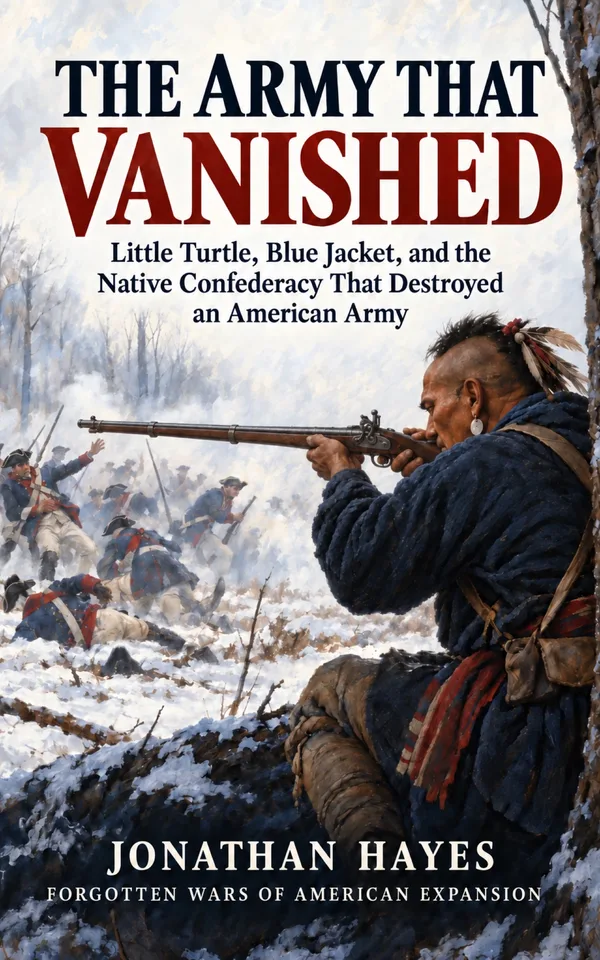
The Army That Vanished: Little Turtle, Blue Jacket, and the Native Confederacy That Destroyed an American Army
by Jonathan Hayes (Author) · Kindle Edition
★★★★★5.0·2 reviews
Part of: Forgotten Wars of American Expansion (3 books)
Read free with Kindle Unlimited
-58%$6.24
Print List Price: $14.99
Available now, delivered instantly to your Kindle
Buy now with 1-ClickRead for free
This is what the series has earned so far:
<what_defines_narrative_history>
Narrative history is not a history lesson with a story attached. It is not a novel about the past, because nothing in it is invented. It is not a chronicle, one thing after another in the order it happened. It occupies its own specific space: a true story, told with a novelist's craft, in which real people move through real scenes toward an outcome that really happened, and the reader feels the weight of it landing on them.
The reader is here to learn what happened, why, and what it cost. But he chose narrative history over every other history on the shelf because he wants to find out what it was like to be there. He wants to live it.The felt engine: CONSEQUENCE. The reader feels that what is happening on this page will cost somebody something real, and reads on to see it come due. Consequence is never manufactured; it already exists in every true story. The writer's job is to place the reader where it is about to land, beside the person it will land on, before it lands. Everything in this framework serves that placement.
The story atom: change, stake, uncertainty. Something changes; someone has a stake in it; the outcome has not yet arrived on the page. Every chapter contains all three. A passage with change and stake but no uncertainty is a summary of what happened. A passage with uncertainty and no stake is trivia. A passage with stake and no change is a portrait. The three together are a story, and a story is what the reader paid for.
The genre runs on two engines in parallel, and both run in every chapter:
- The Story engine. Change, stake, and uncertainty, carried by people the reader can see, in scenes with a place and an hour. Remove it and the book is a textbook.
- The Discovery engine. The reader learns something on every page that he did not know and could not have guessed: how a thing worked, what a document actually said, who a person really was, what was going on behind the version he thought he knew. Remove it and the book is a novel with nothing in it for a reader who chose nonfiction.
A chapter of pure story is a novel. A chapter of pure discovery is a lecture. The two are never separate passages taking turns; the discovery arrives inside the scene, through the person who needed to know it, and the scene is richer for it.
The Textbook Test is this genre's first diagnostic. Remove the people from a chapter and read what is left. If the chapter still stands, it was a textbook chapter, and it is rebuilt around the people it happened to.
The teller knows what came next, and the people did not. At every scale, a line, a scene, a chapter, the narrator holds something the people on the page could not see: that the letter never arrived, that the ship was already taking water, that the man being laughed at would be right. The writer spends that knowledge whenever it does the most work and holds it back whenever it does not. How much of the ending the book gives away, and when, is a decision the Chapter Outline makes for that book; if the Outline books no chapter for telling it, it is not told, and placement does the work. The gap itself is always there, on any subject, and fiction can only fake it.
It happened, so the true particular is the strongest thing on the page. In fiction a detail has to earn belief; here it arrives with it. The real weather on the real morning, the exact words in a real letter, the sum a man really owed: these carry more than anything a novelist could invent, and the writer spends them the way a novelist spends his best inventions, placed where they do the most work, never listed.
Understanding what the reader should feel across the book, a compass, not a prescription: on page one, orientation and a person: he knows what he is reading, where and when he is, why it will matter, and he has met someone. Through the first act, the world assembling around people he is starting to care about, and the first weight of what is coming. Through the middle, the spine tightening, choices made with what the people knew, the reader holding what they could not, discovery arriving inside the scenes. At the turn, the outcome arriving on the people, in scene, at the Scale the book runs at. In the aftermath, the cost counted through the people who bore it, and one true thing the reader did not know when he started, which he now carries out of the book. How loud the narrator is, how close the reader stands, and how fast it moves are dial positions. The journey itself is constant. These feelings are created through placement and selection, never declared by the narrator.
</what_defines_narrative_history>
Consequence, the story atom, the two engines and the Textbook Test. The whole genre, pinned down tightly enough that the AI cannot slide into a textbook on one side or a novel on the other.
2. EM-DASH RULE (delete this whole block to re-enable em-dashes)
Do not use em-dashes (—) anywhere in the prose. Replace each with a period, a comma, a colon, or a rebuilt sentence. Em-dashes are currently the most reader-recognized AI tell; banned by default for publishability, not because they are bad punctuation. If you re-enable them, aim for 10 to 30 per 10k words, with a floor as well as a ceiling. Quotations from documents keep whatever punctuation the source has; the rule governs narration.
END EM-DASH RULE
3. STAY IN THE SCENE: do not step back to comment on it (behavioral; the #1 shared LLM tic)
The single most damaging shared failure is the narrator STEPPING BACK TO COMMENT instead of staying inside the scene. It wears FOUR costumes in this genre, and all are banned:
(a) THE FILING CLERK (the receipt register). Do NOT render the story as a report on its sources: "the record shows," "sources indicate," "according to the surviving accounts," "as the diary confirms," "the evidence suggests," an attribution on every sentence. The reader trusts the book because nothing in it is wrong, not because every line shows its receipt. Attribute once when the source is the stake or the pleasure ("his wife kept the letter"), then write the thing itself. The Framework's attribution family is counted in §9.
(b) THE APHORIST (philosophical maxim). Do NOT lift a moment into a sweeping truth about war, power, men, history, or the past: "Cities, like families, keep their worst secrets longest." Test: if a line could be embroidered on a pillow or open a documentary, kill it. Render the specific thing; cut the universal truth wrapped around it. (Narrow exception: a maxim INSIDE A QUOTATION from a real person who wrote it, set exactly.)
(c) THE SIGNIFICANCE ANNOUNCER. Do NOT label an event, a decision, or a detail as important, fateful, decisive, crucial, momentous, or historic. State the fact and place it next to the thing it will change, and stop: "She signed the lease on the larger premises in March. The bank called the loan in May." Labeling the significance is also the Discovery engine's leak: it tells the reader what to learn instead of letting him learn it.
(d) THE HINDSIGHT NARRATOR (this genre's own costume). Do NOT tell the reader that the narrator knows the ending: "little did they know," "it would be the last," "none of them could have imagined." The placed fact IS the foreknowledge; the reader, holding what the people could not, does the rest. Every announcement of hindsight spends the gap the whole genre runs on.
THE RULE: when the prose is about to FILE the moment, PHILOSOPHIZE about it, ANNOUNCE its significance, or CONFESS its hindsight, cut that move and render the concrete thing: the act, the object, the placed fact, the person's situation. The tragedy-announcer sub-tell is equally banned ("it was a tragedy waiting to happen").
The publishability layer. The em-dash rule, and the four ways an AI narrator steps out of the scene to comment on it, all banned. After every chapter the model runs the counts on the saved file and re-reads it for the bans that no search can find.
How Setup Works
Eighteen steps, in order. At every decision, three developed options with the reasoning behind them and a clear recommendation. Pick one, combine them, or go your own way. Three of the steps go into the sources, and each one asks you first.
The Eighteen Steps
Your starting point
The story inside your subject
Can this book carry its promise? (research)
What the reader thinks he knows
The shape of the story
Whose eyes
How the book reads
Series or standalone
The receipts (research)
Here is your book now
How the book lands
Your book's voice
How the book is told on the page
Title and shelf promise
The writer's check (research)
The readiness pass
Your planning documents
Your workspace
The guided planning conversation. Eighteen steps, three research moments, five planning documents at the end.
The People's Own Words, Copied Exactly
Sargent's Diary, the evening of 3 November 1791:
"Here are an immense number of old and new Indian Camps, and it appears to have been a place of their general resort."
Sargent's Diary, the next morning:
"The firing of the Enemy was preceded for about five minutes by the Indian Yell, the first I ever heard: not terrible, as has been represented, but more resembling an infinitude of horse-bells suddenly opening to you, than any other sound I could compare it to."
A Figure the Book Will Print
Camp to Fort Jefferson: twenty-nine miles. Denny, Sargent and St. Clair agree.
Not to Be Used
"I have been the last to sign the treaty; I shall be the last to break it." Untraceable. Never set.
Every quotation copied from the source itself. Every figure with its source. And every famous line nobody can trace, marked so it never reaches the page.
The Hook
A confederacy of nations north of the Ohio destroys the army the United States sends to take their country, holds the country for four more years, and is beaten at last by a professional army that its own victory forced the republic to build.
The Fresh Angle
What the reader arrives believing: that Native resistance was brave, tribal and essentially reactive, led either by nobody in particular or by one great chief. What the book shows him instead: a working multinational coalition that ran an intelligence system the Americans never matched. What broke it was politics, not muskets.
Where the Outcome Is Told
Nowhere. No chapter tells the reader how it ends. The reader who knows feels it, and the reader who does not finds out when the people do.
The story, the angle, whose eyes, the dials and the voice. The book's DNA, and every ruling on what it will and will not say.
Where the Sources Disagree
Who commanded at the Wabash. Tradition and American accounts credit Little Turtle. A prisoner report names Blue Jacket, and one modern historian argues for him. Nobody American saw the confederacy's order of battle. Ruling: state both, follow neither.
The Silences
The confederacy left no writing of its own. Its councils reach us through American and British clerks and interpreters, its decisions mainly through what it then did.
The story as the record holds it: every quotation, figure and dispute with its source, and every silence named. The chapters never search; everything they need is here.
Little Turtle
Locked form: Little Turtle. First appearance: Mihsihkinaahkwa, called Little Turtle. Source spellings, for recognition only: Michikinakoua, Me-She-Kin-No-Quah, Meshecunnaqua.
Tag: the man who says the marks of his forefathers' houses are still on the ground, and points at it.
Names a Modern Reader Cannot Hold
Kekionga, the Myaamia capital. Not to be confused with the Glaize, a different confluence forty miles east.
Every person, place and nation, with one locked spelling each, so a name never drifts across 80,000 words.
The Book
A prologue and twenty-eight chapters. 2,500 to 3,000 words each. About 79,000 words.
Prologue, Before Sunrise
The upper Wabash, 3 and 4 November 1791.
Through-line: an army that could count everything it lacked and nothing that was coming for it.
What happens: the army halts on the rise late in the day and does not dig. The night on the militia flat, with no supper and the woods in front. The drum before first light. Then the woods ring, and the chapter stops.
Every chapter mapped: whose eyes, the through-line, the discovery, the receipts it spends, and where it stops.
BOOK STATE: THE ARMY THAT VANISHED. Initial
No chapter written yet.
Told: the outcome is never stated, in any chapter.
Next: the Prologue, Before Sunrise.
Updated after every chapter. It holds what the book has already spent, so nothing is told twice and nothing contradicts itself.
BOOK STATE: THE ARMY THAT VANISHED. After the Prologue
Research Bible Entries Used
Prologue: Q-W1, Q-W3, Q-W6, F10.
Particulars Committed
The stream in front of the camp is never named and never given a width. The length of the day's march is not stated.
Watched Figures
Two shapes, at most once a chapter: an opening sentence that ends on a because-clause explaining the act, and a one-line paragraph that states a distance or an hour and stops.
Updated after every chapter. What the book has already spent, so nothing is told twice.
Where the Book Ends
The Prologue and twenty-eight numbered chapters are written, closed and counted.
The Outcome as Told
Never stated. No sentence in the book pronounces the war decided or the confederacy finished. The last chapter carries the confederacy's ending by placement only, with no narrator's word on it.
The book's closing record. The notes and the bibliography are built from it, and the next book in the series starts from it.